Showing posts sorted by relevance for query healthy narcissism. Sort by date Show all posts

January 15, 2010

Healthy Narcissism and Self-Admiration


Hide and Seek by James Tissot 


“Healthy narcissism plays a crucial role in the human capacity to manage challenges, successes and changes; to overcome defeats, illnesses, trauma, and losses; to love and be productive and creative; and to experience happiness, satisfaction, and acceptance of the course of one’s life.

“In a broad sense, narcissism refers to feelings and attitudes towards one’s own self and to normal development and self-regulation. It is the core of normal healthy self-esteem, affects, and relationships. In psychoanalytic terms, normal narcissism is defined as a positive investment in a normally functioning self-structure.” ~Elsa Ronningstam


Is narcissism healthy? “Healthy For Whom?”

This is the question Jean Twenge and Keith Campbell ask in their book, The Narcissism Epidemic. For those who have suffered narcissistic abuse and/or life-altering trauma, narcissism is a pejorative. Narcissists hurt people, victimize innocent others, & destroy people’s meaningful beliefs about themselves and the world. Anyone who has dealt with a narcissist might question the idea that narcissism is healthy. We know from first-hand experience that narcissism is a destructive element in all relationships. We know narcissist’s excessive self-admiration develops hubris, arrogance, alienation from others, and as theorized by psychologists: alienation (disconnection) from their True Self.

Healthy Narcissism appears to be an oxymoron if you have been the victim of a narcissist’s aggressive, destructive, malignant envy, and (sad to say) intentional malice. 

A few weeks ago, an anonymous poster left a comment challenging my post on "healthy" narcissism. Our disagreement may be based on confusion between the psychodynamic definition of healthy narcissism and narcissism as a personality trait. Let me try to define the distinction between narcissism as the foundation to stable self-esteem in contrast to narcissism as measured by the NPI (Narcissistic Personality Inventory). 

Healthy Narcissism as a Psychodynamic Process

“In a broad sense, narcissism refers to feelings and attitudes toward one’s own self and to normal development and self-regulation. It is the core of normal healthy self-esteem, affects, and relationships. In psychoanalytic terms, normal narcissism is defined as a positive investment in a normally functioning self-structure.” ~Elsa Ronningstam, (page 31)

Healthy narcissism is the foundation to stable self-esteem that is not subject to extreme fluctuations. Failures, mistakes, stress, or even successes can threaten 'fragile' self-esteem, deflating or inflating one's self-perceptions to an unhealthy degree. Connecting to an inner core of the True Self is essential for establishing healthy narcissism. In other words, connection with the True feeling Self sustains our worth in times of crisis, severe stress, and increases our capacity to grieve significant losses.

Though psychological theories might differ on the etiology of pathological narcissism, psychologists agree that healthy narcissism evolves from a secure attachment to parental figures in childhood. Adoring parents who, if they are doing their job well, slowly frustrate our self-centeredness. This will set limits on selfish behavior and grandiosity. Through consistent mirroring of our ‘specialness’, we come to trust we are lovable, valuable, and worthy. Our self-esteem is less susceptible to extreme fluctuations in reaction to criticism or failure.

Healthy narcissism increases tolerance for shame, guilt, and remorse—fundamental to healthy social integration. Our narcissism is held in check by our capacity to empathize and introspect, by the value we place on community, and our ability to commit to others. These abilities restrain unhealthy narcissism thus deepening bonds to others and to the self.

Using this understanding of ‘healthy narcissism’ as a developmental process, we can say that someone with a Narcissistic Personality may be unhealthy, but not necessarily pathological; i.e.: resistant to treatment, change, or cure. What we define as a Narcissistic Personality Disorder.

A Narcissistic Personality Disorder
Clinical Narcissism

In a clinical description, a person either IS a narcissist, or is NOT a narcissist. Qualified professionals make this determination based on observation of at least five qualifying criteria out of nine listed in the DSM-IV. These nine criteria are subject to change as research clarifies varying manifestations of a narcissistic personality disorder. A person with a suspected NPD will have impaired relationships, a long-term pattern of narcissistic behaviors, rigid defenses, work failures, even depression, and/or suicidal episodes. Anyone diagnosed with a narcissistic personality disorder manifests unhealthy narcissism.

The narcissistic personality disorder is a clinical diagnosis much like a medical diagnosis. In other words, you either have a broken leg or you don’t. To clinical psychologists, a person has a Narcissistic Personality Disorder or they don’t. If they have a NPD however, the narcissistic traits are pathological because their narcissism is unhealthy. To suggest that someone with a narcissistic personality disorder exhibits ‘healthy narcissism’ is a fallacy.

Unfortunately, many of their character traits are viewed as valuable in a competitive society. Most people who are hurt by narcissists were basing their perceptions of narcissism on faulty knowledge about personality disorders. The pathological Narcissistic Personality Disorder is often mistaken for its look-alike cousin: A Narcissistic Personality.

A Narcissistic Personality
Non-clinical narcissism

"Self-admiration sounds great and is a central tenet of modern American culture. But self-admiration taken too far has a distinct downside: narcissism and all of the negative behaviors that flow from it." ~The Narcissism Epidemic (page 18)

Using the Narcissistic Personality Inventory (the NPI), researchers like Twenge and Campbell measure non-clinical narcissism. Discerning narcissism as a personality trait means someone may be labelled A Narcissist if their score on the NPI exceeds social norms. The NPI merely says that someone has high narcissistic traits in comparison to most people.

The degree of their narcissism might be 'unhealthy' even though psychologically, they have healthy-enough narcissism to support the work they must do countering egotistical behaviors causing relational problems with others and with themselves.

Note: If someone has a high score on the NPI, then they may want to consult with a professional psychologist who can diagnose whether or not they have a personality disorder. Also, an excessively low score on the NPI might indicate a lack of healthy narcissism. A low sense of entitlement may or may not be indication of a narcissistic pathology. Sometimes separating from the narcissist is all people have to do to restore their self-esteem. Establishing intimate, successful, and satisfying relationships increases our sense of competence and worth.

To a non-narcissist, community is valuable; arrogant self-sufficiency is a lie; and affective bonds to intimate relationships are a priority. (Get to know people who are not pathologically narcissistic and your self-confidence will be restored.)

Social research measures the degree of narcissistic traits in a 'non-clinical' personality. Someone with a narcissistic personality may be capable of sustaining relationships, forming intimate bonds with others, and excelling in the workplace without being pathological. In other words, they empathize with others, have compassion, suffer guilt and remorse, are loyal, and maintain social values contributing to mental health---values which temper unhealthy narcissism. However, others may perceive them as arrogant, pompous, overly focused on image or ‘self’ and invested in getting whatever they want at other people's expense.

All narcissists are hard to live with requiring empathic partners who will restrict their selfishness by setting boundaries on entitlement and self-serving behaviors. When narcissists are called on their bad behavior, they may be able to resolve or eradicate unhealthy narcissism because they VALUE relationships, experience empathy, and have the capacity to introspect, grieve, mourn and change behaviors that create the problems their self-admiration is causing.

“People with healthy levels of narcissism are also able to step outside their own perspective long enough to assess how their behavior may be affecting others around them. This ability to avoid becoming stuck in narcissistic mode, and to consider the impact of your actions on the feelings of others, is one of the key distinctions between healthy and extreme levels of narcissism.” Drew Pinsky, (page 90)

Normalizing Narcissism: self-admiration

“If you need others to admire you and be the source of your self esteem you are not "healthy".” ~Alice Miller

If self-admiration becomes the 'norm' for human behavior, then an average score on the NPI is not an indication of mental health even if society normalizes narcissistic behavior. The more society views narcissistic traits as healthy (normal), the unhealthier we become. Perceiving narcissistic behavior as healthy in a non-clinical setting is a misnomer for it is never healthy to be selfish, egotistical, self-admiring, superior to others, self-serving, inordinately self-sufficient, or to compensate for mortal weaknesses and vulnerabilities with an inflated ego. And it goes without saying that it is never beneficial to society when individual entitlement justifies using people to meet one's own needs (exploitativeness) without restriction.

Self-admiration may be considered normal these days, but that does not mean it is ‘healthy’. As long as we tolerate self-admiration as normal, we hinder communal values that must be sustained for our society to be healthy, to raise productive children, to counter anti-social behavior and eliminate self-centeredness destroying public safety, trust, and everyone’s freedom.

This is where my concern rests today: the normalization of self-admiration. The more normal or healthy we consider narcissistic traits to be, such as blatant self-promotion and a drive for ‘uniqueness’, the further we get from communal values fostering life satisfaction. Ask any older person what gave their lives meaning and they generally say, “My family. My friends. My relationships.” Rarely will anyone declare that self-admiration brought joy and fulfillment. This perspective may change if fame and fortune are normalized as the measure of human success (I believe we are witnessing this change in our culture today as fame/celebrity becomes a valued goal). If we want our children to be successful in life, then subscribing to the narcissistic standard of self-admiration validated by admiring others is a sure method for thwarting everyone’s happiness.

Narcissism, as defined by excessive self-admiration, is never healthy. It is always destructive to one’s self and most assuredly, to others.

Healthy Narcissism mitigates unhealthy narcissism

“Whoever loves becomes humble. Those who love have, so to speak, pawned a part of their narcissism.” ~Sigmund Freud

Maturation requires a voluntary sacrifice of childish narcissism. Maturation demands relinquishing our preoccupation with the self: omnipotence, superiority to others, arrogance, omniscience, viewing the self as the center of the universe. Our narcissism is whittled away when life challenges mortal hubris.

“The ultimate blow to narcissism is the fact of our own death; coming to terms with death is a mark of maturity and wisdom. For [Heinz] Kohut, narcissism, successfully negotiated, leads to the capacity to accept mortality, to see oneself as one is without over-or-underestimation, to develop a sense of creativity and humour and to trust one’s intuition and empathy. The paradox of this process is that narcissism needs to be healthily established before it can be given up.” Jeremy Holmes (page 43)

If our narcissism has not been surrendered by midlife, a crisis between self-perception and reality results. If we developed healthy-enough narcissism during childhood, an intimate connection to the True Self will cushion adult fragility, increase resiliency, initiate acceptance of our extraordinary ordinariness, and sustain a legitimate grieving of our losses…including the willing sacrifice of our narcissism.

Hugs,
CZ

Resources

Ideas in Psychoanalysis: Narcissism by Jeremy Holmes

Identifying and Understanding the Narcissistic Personality by Elsa F. Ronningstam

Living in the Age of Entitlement: The Narcissism Epidemic by Jean M. Twenge and W. Keith Campbell

The Mirror Effect by Drew Pinsky and S. Mark Young

April 10, 2008

Descriptions of Healthy Narcissism


Check this link: Healthy Narcissism


"Healthy adult narcissism is characterized by empathy, a sense of humor, creativity, wisdom, sense of personal responsibility, the capacity for developing and maintaining satisfying intimate relationships and altruism. This is the ideal state for adults."


"My way of looking at narcissism is as a continuum. Narcissism is like a dementia: from healthy narcissism to pathological to narcissistic personality disorder to psychopathy. It is important to see that everybody has narcissism, self esteem, self regard, self protection and a normal sense of entitlement. There are a lot of normal aspects to narcissism. In stressful situations, anybody's self esteem can react to the extreme temporarily."
~Dr. Elsa Ronningstam

* * *

"Healthy narcissism is a mature, balanced love of oneself coupled with a stable sense of self-worth and self-esteem. Healthy narcissism implies knowledge of one's boundaries and a proportionate and realistic appraisal of one's achievements and traits." ~Sam Vaknin
* * *
"Healthy narcissism is the appearance of a strong, vital, cohesive self striving with ambition and ideals toward the full realization of a person's skills and talents. Healthy drives for growth possess a greater sense of urgency and strength than unhealthy drives to repeat the past. " ~Link:Heinz Kohut, CandleInTheDark

* * *
"A distinction must be made between 'normal' or 'healthy' narcissism on the one hand and 'pathological' narcissism on the other. We all have some degree and variety of narcissistic delusion which, if it is not too great, is normal and healthy. But the pathological narcissist has a level of delusion that is divorced from reality.

Kernberg used a theoretical frame to differentiate between 'normal' and 'pathological' narcissism, combining ego psychology and object relations theory. Normal narcissism refers to well integrated representations of the self and others, whilst pathological narcissism relates to an impaired intrapsychic structure with grandiose self-representation and a severe pathology in object relations. Lubit compared 'healthy' and 'destructive' narcissism in relation to their long-term impact on organizations." ~ View this link to see a comparison table between healthy and unhealthy narcissism: Winning Teams

* * *

"Getting a good balance between taking from others and giving to them is called "Healthy Narcissism" by the psychoanalytic community. Healthy Narcissism is the ability to have reciprocal relationships where the need of each of the partners is balanced with the needs of the other.

Healthy narcissism is having just the right amount of self centeredness to get some of your own needs met and as well as some of the needs of others. It’s a balance between giving and taking. Healthy narcissism means using appropriate adult communication, having appropriate boundaries and setting limits for your own self protection. It means giving up old survival patterns that no longer work and using adult behaviors that give you more of what you want.

Mature Healthy Narcissism is the middle ground between caring for self and the caring for other. It includes those centered, conscious choices that fall within the center of the continuum. It is the equilibrium between taking too much and giving too much in regards to the other person. Moving towards the middle of the Narcissistic-Co-dependency continuum where there is not too much and not too little of either giving too much to others or expecting too much brings balance into a life. By learning the balance between giving too much and taking too much and learning the skills of communication that create intimacy." ~Link: The narcissistic co-dependency continuum 
by Lynn Namka

* * *

"The practical test, so far as I know, is that with normal people, no matter how difficult, you can get some improvements, at least temporarily, by saying, essentially, "Please have a heart." This doesn't work with narcissists; in fact, it usually makes things worse." ~Joanna M. Ashmun

* * *
"...it is not ideal to divest everybody of narcissism because normal narcissism is a source of pleasure in living, of enjoyment of self, enjoyment of healthy self-affirmation, healthy aggression, enjoyment of sexuality, eroticism, love, intimacy. This is all part of normal narcissism. And what I am trying to say, in essence, is that I see no contradiction between normal narcissism and the spiritual orientation, although there is all the contradiction in the world between abnormal narcissism and spirituality." ~Otto Kernberg, The Seeds of Self

* * *
"At the same time, one can certainly look at the early tendency for a child to be egocentric. This is a natural thing, but we could say that as you grow up, what you must learn to do is to conquer your egocentricity. This is not saying, though, that you're conquering your ego. This is an aspect of your behavior, of your attitude. And you must conquer your egocentricity and learn to develop consideration for other people. Now if you do this, you can hold on to your ego—and by this I mean the sense of the direction of the person in terms of how they envision their development in life—and you'll be fine." ~Henry Stein on Alfred Adler

* * *
"Healthy narcissism is a realistic sense of self that is based in one’s real assets; and the confidence to risk failure and to sustain effort towards some goal." ~Dr. Sandy Hotchkiss 


March 15, 2008

Healthy Narcissism


“Healthy narcissism plays a crucial role in the human capacity to manage challenges, successes and changes; to overcome defeats, illnesses, trauma, and losses; to love and be productive and creative; and to experience happiness, satisfaction, and acceptance of the course of one’s life.

“In a broad sense, narcissism refers to feelings and attitudes towards one’s own self and to normal development and self-regulation. It is the core of normal healthy self-esteem, affects, and relationships. In psychoanalytic terms, normal narcissism is defined as a positive investment in a normally functioning self-structure.” ~Elsa Ronningstam

"Every human being needs admiration and attention, has an occasional lack of empathy, a desire for success and love. Every human being likes having power and control and might be a tad grandiose and self-important, once-in-a-while." 

"Healthy narcissism is the foundation to stable self-esteem that is not subject to extreme fluctuations. Failures, mistakes, stress, or even successes can threaten 'fragile' self-esteem, deflating or inflating one's self-perceptions to an unhealthy degree. Connecting to an inner core of the True Self is essential for establishing healthy narcissism. In other words, connection with the True feeling Self sustains our worth in times of crisis, severe stress, and increases our capacity to grieve significant losses."

"I got me sum narcissism. You got you sum narcissism. To sum degree, everybody's got sum narcissism in 'um. It might be healthy and it might not be. We may have higher than average narcissism like the celebrity stars Pinsky and Young tested. Or our narcissism might be lower than average and as a result, we don't take very good care of ourselves. Our narcissism could be annoying to others and even to ourselves but not being narcissistic at all is no sign of mental health either."

Corrective Disillusionment and Healthy Narcissism
A stable self-esteem (healthy narcissism) increases emotional resiliency and maintains ego integrity during life challenges. On the other hand, narcissists are defined as having unstable self-esteem, which means they are limited in their ability to cope with screw-ups. Narcissistic defenses ward against perceived slights and criticisms, feelings of shame and self-doubt, perceptions of inferiority and insufficiency---further erosion of an unstable self-esteem.

Normal narcissism includes the ability to form deep object relations, emotional bonds, mutual giving and taking, a realistic self-interest, empathy for others, and accurate self-knowledge. Healthy narcissism allows people to tolerate criticism and failure, and contain negative feelings like guilt which leads to even deeper pro-social emotions like remorse and forgiveness. Healthy narcissism, as described by Heinz Kohut, includes creativity, empathy, a sense of humor, awareness of finiteness, and wisdom.

Mental and psychological health requires a balancing of  agency and communion. Once again, Masterson's words are worth repeating: "All the capacities of the real self come under the heading of normal narcissism, which in effect is the capacity to identify what you want and need, get yourself together, and go after it, while also taking into account the welfare of others. This is the healthy way to feel good about yourself. " 


Other Resources

"Some have referred to Kohut’s Psychology of the Self as "psychoanalysis without original sin"—i.e., the “original sin” that Freud considered Narcissism. One of Kohut’s breaks with Freudian tradition is that he considered Narcissism affirmatively, as an essential part of the Self; and described how it develops in the healthy individual..."
"Mature Healthy Narcissism is the middle ground between caring for self and the caring for other. It includes those centered, conscious choices that fall within the center of the continuum. It is the equilibrium between taking too much and giving too much in regards to the other person..."

Self-Efficacy
 by Dr. Albert Bandura
"A strong sense of efficacy enhances human accomplishment and personal well-being in many ways. People with high assurance in their capabilities approach difficult tasks as challenges to be mastered rather than as threats to be avoided. Such an efficacious outlook fosters intrinsic interest and deep engrossment in activities. They set themselves challenging goals and maintain strong commitment to them. They heighten and sustain their efforts in the face of failure. They quickly recover their sense of efficacy after failures or setbacks. They attribute failure to insufficient effort or deficient knowledge and skills which are acquirable. They approach threatening situations with assurance that they can exercise control over them. Such an efficacious outlook produces personal accomplishments, reduces stress and lowers vulnerability to depression..."

"In sum, healthy self-esteem refers to realistic and accurate positive appraisals of the self on significant criteria across a variety of interpersonal situations. It also includes the ability to cope with the inevitability of some negative feedback. By contrast, unhealthy self-esteem, as in narcissism, refers to insensitivity to others, with excessive preoccupation with the self and one's own image and appearance in the eyes of others."


April 30, 2012

Healthy Narcissism or Pathological Narcissism


Where best to find a cabbage than a cabbage patch? 


It's important to me, that readers understand why my blog is titled The Narcissistic Continuum and not  NPD: The NarcoPath Files. 

I chose The Narcissistic Continuum because it best reflects my understanding of narcissism as a dimensional trait. I got me sum narcissism. You got you sum narcissism. To sum degree, everybody's got sum narcissism in 'um. It might be healthy and it might not be. We may have higher than average narcissism like the celebrity stars Pinsky and Young tested. Or our narcissism might be lower than average and as a result, we don't take very good care of ourselves. Our narcissism could be annoying to others and even to ourselves but not being narcissistic at all is no sign of mental health either. 

Healthy narcissism motivates us to write a blog, believing our lives are worth reading about. Healthy narcissism urges us to post comments, believing our opinions are worth saying. (YouTube opinions excluded from the worthiness continuum---that's super-steroidal-quality-narcissism and you do not want any of that!). 

Healthy narcissism is having enough self-worth to use the capital "I" without fainting. The capital "I" familiarizes us with ourselves. Me, myself and I enhances self-awareness. For those of us who weren't quite sure who we were or what we stood for, the capital "I" is our best friend during recovery. "I think this..." and "I am that..." and "I, I, I." It's important to rustle up enough courage to say "I".

I dare you to write fifteen capital "I"s in one paragraph...without sweating or deleting. 

Healthy narcissism holds us steady when critics are counting our "I"s. And they probably aren't totaling numbers for healthy narcissism either, they're looking for proof of our big fat egos. Little do they know that narcissists, I mean the seriously pathological narcissists, are loath to reveal anything about themselves that other people  could use against them. When you say "I was c-r-u-s-h-e-d when my sister said I talked too much", well, that would be TMI for a pathological narcissist. The pathological narcissist thinks to herself, "I can't let people know what makes me feel bad. Then everyone would attack me."

The pathological narcissist defends him/herself from real relationships which depend on vulnerability and trust. Healthy narcissism means risking intimacy. Risking rejection. Trusting you won't be. Trying again if you are.

Healthy narcissism gets you out of the bed in the morning. Healthy narcissism gets you dressed instead of wearing flannel pajamas to dinner. Wait! Strike that last description. Healthy narcissism means you like yourself even when you're wearing flannel pajamas while fixing beans and weenies for dinner. If you stay in your pajamas longer than a week and don't take a shower, unhealthy narcissism will defend your own stink. If people insist you shower and you get pissed off and tell them they stink worse than you do and they always have but you loved them too much to tell them that and you get really really mad and say nobody's ever gonna tell you what to do especially not some freakin' freeloader so take that and your damn shower and well...that would be pathological narcissism. 

If your spouse doesn't notice you've been wearing the same pajamas for a week, that would be the narcissistic relationship. The worse you look the better they feel so let's eat beans for every meal. J'est kiddin'. Not really. I died my hair blonde once and it took two days for my husbaNd to notice. I pretended it didn't matter but my self-esteem took a nosedive. If you are in love with a pathological narcissist, your self-esteem will take lots of nosedives and pretty soon, you won't bother washing your hair or adding weenies to your beans.

Pathological narcissism: Narcissistic Personality Disorder

On most blogs, people are writing about pathological narcissism: the Narcissistic Personality Disorder. Sometimes people email asking why I'm so flippant about narcissism because narcissists are mean and cruel and rotten, hadn't I ever seen a Vaknin video? Why on earth would anyone laugh about narcissism. Am I making light of people's misery? 

No, no...not at all! There's nothing funny about pathological narcissism or malignant narcissism. But to me, there's a helluva whole lotta funny about non-pathological narcissism, the unhealthy kind that makes us act like children and defend our behavior at all costs to reality. I've experienced startling moments of clarity when the moat suddenly lifted from mine eyes and I could clearly see that the problem was me. Not he, thee, or she. So if you've got insight...use it. And count your lucky stars because not everyone recognizes their own head amongst the rising stink of a cabbage patch. 

Are there any signs that someone might be pathological?

Two distinguishing characteristics between normal and pathological narcissism are: 1) the capacity for insight which I mentioned already, and; 2) extreme reactions to criticism and failure, as in hostile, viperous, caustic, aggression with a capital A.

Now the truth is, I don't enjoy failing. Especially in front of witnesses. My self-esteem plummets for three days.  I've got it timed, that's how often it happens. After three days of self-pity, I get back up and start over with a more realistic appraisal of my skills and abilities. A little more humble, a little more grounded, a little less narcissistic. 

That's not what pathological narcissists do. 

Pathological narcissists blame other people for their failures and shoot witnesses. Pathological narcissists smear reputations so nobody believes any version of events other than the narcissist's, of course. What you won't see pathological narcissists do is get back up and say, "I failed and it was nobody's fault but mine." 

So here's to healthy narcissism! May failure be our teacher. Insight become our guide. And if you are still in your pajamas, Here's to ya! (just take a shower once a week, will ya? Is that too much to ask?!)

Hugs,
CZ

October 21, 2012

Testing Normal and Yucky Narcissism


"Normal narcissism is vital for satisfaction and survival. All the capacities of the real self come under the heading of normal narcissism, which in effect is the capacity to identify what you want and need, get yourself together, and go after it, while also taking into account the welfare of others. This is the healthy way to feel good about yourself. This important distinction between healthy and pathological narcissism has been blurred by the tendency to see all narcissism as pathological." ~James. F. Masterson

One of the top five posts on my blog is an essay titled, "Help! I'm a Narcissist! This essay was written in response to readers who admitted excessive self-preoccupation was affecting their relationships. They asked for resources because they feared narcissism was limiting their lives. I can corroborate that point---unchecked, untreated, unmodified narcissism ruins relationships.

My concern is that people with high scores on narcissism tests, automatically assume they're pathological narcissists, the types of narcissists people are writing about on blogs and websites. This brief essay describes normal narcissism which ranges from healthy to unhealthy. Normal narcissism MUST BE be distinguished from the pathological narcissism causing inestimable pain to individuals and society. That does not mean unhealthy narcissism is a good thing but it's not as intractable as pathological narcissism. In other words, you can change unhealthy narcissism for the better.
"People at the psychologically healthy  end of the narcissism continuum exhibit these traits in normal, moderated levels. People at the other end manifest their narcissistic traits in such extreme ways that they demonstrate the pathologies of narcissistic personality disorder. In between lies a spectrum of infinite gradation."~Dr. Drew Pinsky and Mark Young, The Mirror Effect, page 89
A couple of tests measuring narcissism are available to the public and they're linked below. What you need to know before taking these tests is that they measure normal narcissism, not pathological narcissism. So do NOT freak out if you take the Narcissistic Personality Inventory and discover you're on the high end of the continuum which puts you in the same league as Robin QuiversWhen Dr. Drew Pinsky measured her normal narcissism, she scored a 34. The average is 15.3.

Thirty-four is higher than the scores people have reported on my blog which are generally below  average. Lower scores m-i-g-h-t reflect people's knowledge about narcissism because anyone reading my blog is relatively well-informed. We know which box to tick and which not to which could (not sayin' it does) lead to self-deception; i.e.: we cheat. It's hard not to cheat on a narcissism test because according to James F. Masterson, "The important distinction between healthy and pathological narcissism has been blurred by the tendency to see all narcissism as pathological." Narcissism is a test you hope to fail unless you understand that narcissism is part of everyone's personality. Narcissism can be healthy; it can be pathological; it can be malignant.

I believe we need to get comfortable with everyone's narcissism as a constellation of personality traits which does not in any way, minimize the damage pathological narcissism does to people and society. We're still in the process of understanding how narcissism functions in the regulation of self-esteem and there's a lot of confusion about narcissism as a categorical and/or characterological disorder. This likely happened when narcissism websites first hit the Internet and people were desperate for information (myself included). The Jekyl-Hyde narcissism being described ten years ago was a mix of extreme narcissism combined with psychopathy, and a pinch of anti-social personality traits thrown in for narcs who broke the law.

Suggesting oneself to have narcissistic traits at that point, was akin to saying you kept dead bodies in your basement. People were highly resistant to narcissism being defined as anything other than pathological.  On my blog, my title is a dead giveaway. I think the narcissistic continuum is a useful conceptual model described by Dr. Nina Brown in her book Destructive Narcissistic Patterns. Her model ranges from healthy narcissism to pathological narcissism and it just made sense to me to look at narcissism that way.

I am 100% in support of anyone taking an honest look at themselves. So take a look at yourself. If you don't like what you see, congratulate yourself for being able to tolerate your imperfections and flaws! If you're ecstatic about what you see, don't tell me because my blog presumes y'all have come to grips with the fact that our societies are increasingly narcissistic which means we are primed to see ourselves as unique individuals and special. Whoever we are, and whatever we want, or however we act is fine, as long as we're comfortable with ourselves because what really matters is how we feel about ourselves--even if our special feelings make other people feel very unspecial, even terrible about themselves and that is truly yucky. 

So this is my test measuring Yucky Narcissism and I made it up myself. 

Sit in a lotus position. Drape your hands gently over your knees and imagine your fingers to be fluffy floating flowers in the free-flowing sea foam of life.  Breath in deeply...hold it. Now exhale...hold it. Repeat this breath work five times. When your chakras have lit up like a modem after a power surge, and you're fully relaxed but not sleeping, repeat after me: 

"I am an ordinary person having an ordinary experience." 

Now check your feet. Are they squinched up? Score two points for each toe twitch. Check your fists. Are they doubled up? Score three point for each fingernail dent in your palm. Check the top of your hands. If you're white knuckling your ordinariness and oh-so-not-special self, add fifty points to your score.  Any score above zero means your narcissism could use some attention. Any scores higher than seventy could possibly---if you aren't careful---make your head explode.

For other tests considered more valid than mine, go to these links and test yourself: the Narcissistic Personality Inventory (NPI) and the The Hypersensitive Narcissism Scale (HSNS).

If at this point, you're itching to write a nasty email to me for even hinting you might not be special and unique and entitled to exploit people to meet your needs, find a clinical psychologist who can assess whether or not you're dealing with pathological narcissism.

HINT: If you're getting along reasonably well with your family, co-workers and the people next door, you aren't dealing with pathological narcissism. Just the Yucky Narcissism people deal with everyday in a culture that panders to our every whim from television commercials to pick-yer-stories news feeds. People with pathological narcissism, what clinicians diagnose as a Narcissistic Personality Disorder, suffer significant impairments with: 1) other people (interpersonal); 2) with the self (intrapersonal).

In my experience, maturation challenges normal narcissism. Maybe that's because the older we get, the more time we've had to make mistakes. The accumulation of personal stupidity over a lifetime tends to take a toll on immatured hubris. Takes the edge off youthful grandiosity. Humbles our egos if we let it. Complaints and criticism from other people CAN BE a powerful motivator. There's the kicker though, folks. Feedback from other people is a powerful motivator if we value other people. 
"All the capacities of the real self come under the heading of normal narcissism, which in effect is the capacity to identify what you want and need, get yourself together, and go after it, while also taking into account the welfare of others. This is the healthy way to feel good about yourself."~James Masterson
As long as narcissistic people are getting what they want and nobody complains, they won't question their entitlement to serve themselves without taking into account the welfare of others. So, IF and WHEN somebody complains about being treated badly, like a wife or husband, the kids, parents, a favorite Aunt or Uncle, and then yea, let's add co-workers and the boss, and maybe the Welcome Wagon committee in the neighborhood, and the local Starbucks barrista and the chubby choir director, well...that usually gets the narcissist's attention and THEN it takes a LOT of his or her TIME getting rid of all those people.

That is not Normal or Yucky Narcissism. You get my drift.

Normal narcissism includes the ability to form deep object relations, emotional bonds, mutual giving and taking, a realistic self-interest, empathy for others, and accurate self-knowledge. Healthy narcissism allows people to tolerate criticism and failure, and contain negative feelings like guilt which leads to even deeper pro-social emotions like remorse and forgiveness. Healthy narcissism, as described by Heinz Kohut, includes creativity, empathy, a sense of humor, awareness of finiteness, and wisdom.
"Our capacity to change is there if we are willing to tap into its potential and allow ourselves to experience the intense and uncomfortable emotions that usually accompany this experience...Sometimes the change is painful, and there are times when we need the expertise of a competent therapist to guide and support us. A sense of meaning, purpose and fulfillment can be the reward for undertaking this process."~ Dr. Nina Brown
My next post will feature a variety of books and resources that inform and challenge narcissistic behaviors inhibiting the development of healthy relationships with other people and with the self.


Hugs,
CZ

Other posts that may be of interest:

Healthy Narcissism and Admiration

Narcissistic Traits and the NPI

Healthy Narcissism or Pathological Narcissism

Descriptions of Healthy Narcissism

Normal or Malignant Narcissism?


Resources

Nina Brown. The Destructive Narcissistic Pattern. 1998

Alexander Lowen. Narcissism: Denial of the True Self. 1985

James. F. Masterson. The Search for the Real Self. 1988

Drew Pinsky and Mark S. Young. The Mirror Effect. 2009


November 15, 2013

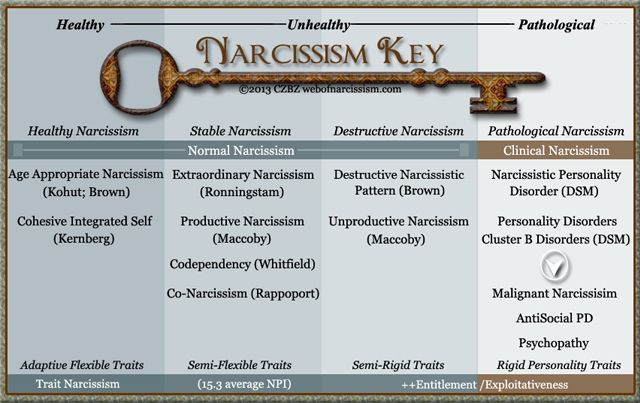
Narcissism Key: from healthy to pathological


Without a working framework, my blog might be confusing because I write about narcissism as a normal personality trait while writing about pathological narcissism as a clinical diagnosis. I also write about my struggles with unhealthy narcissism which should not be equated to a personality disorder. (Unless you hate me and then you can accuse me of having a NPD which a few people have surmised. Hint: none of them was my therapist or my kids, the latter being more credible...)

So what does narcissism mean to you? Is narcissism a concept in psychoanalytic theory, a trait, a process, a personality variable, a disorder? Narcissism confounds most people and yours truly is frequently confused which is why narcissism remains endlessly fascinating and frustrating. Social psychologists disagree with clinical psychologists who disagree among themselves: is narcissism a part of normal psychological development as Kohut theorized; or is narcissism as Otto Kernberg suggests: "the libidinal investment in a pathological self-structure,” i.e.: the inability to love others.

To most people, narcissism is an air of superiority, a lack of empathy, obliviousness to the impact their behavior has on others. Narcissism is blaming, shaming, and defaming anyone who dares offend or criticize. To many people, narcissism means "never having to say you're sorry" because everyone should want what's best for the narcissist, even if it isn't best for themselves. To most of us, narcissism is Gross Hypocrisy--saying one thing while doing another; claiming to be better than we actually are (okay social psychologists, it's true...everyone self-enhances but not to the point of absurdity-and-nonsense).

Descriptions of narcissism in the clinical/pathological literature also describe the normal narcissism of nonclinical/normal populations. Every human being needs admiration and attention, has an occasional lack of empathy, a desire for success and love. Every human being likes having power and control and might be a tad grandiose and self-important, once-in-a-while. Two other traits causing relational problems for all of us? Using others to meet our needs; i.e.: Entitlement and Exploitation. It's frustrating knowing where to peg someone on the narcissism spectrum, including where we might find ourselves. Now some people might argue that measuring someone's narcissism is an exercise in judgmentalism. That may be true in some cases but it's crucial for understanding how pathological someone's narcissism might be, especially when deciding to end the relationship or stay. We need to be as clear-eyed as possible. An everyday "normal narcissist" will hurt our feelings and push our boundaries beyond comfort levels; a malignant narcissist will push us "over the edge". Metaphorically and literally, my friends.

As you can see on the graph, normal narcissism doesn't necessarily mean healthy and quite honestly, the vast majority of human beings fall short of the ideal. Modifying unhealthy narcissism as soon as we 'catch ourselves in the act' allows us to live to our fullest potential. So instead of denying we have issues, let's cop to our crimes-and-misdemeanors and get to work on being human: interconnected, conscientious, compassionate, communal, and kind.

As a disclaimer: my graph is intended for self-helpers. I have referenced social and clinical psychologists most readers will recognize, including credible resources for each position on the graph. Numerous quotes are incorporated in my article because I'm not a psychologist and have zero-absolutely-no interest promoting myself as such. This graph is a working framework of my layperson understanding of social, clinical, normal, developmental and abnormal antisocial white flag narcissism.  Be sure to check out my bibliography and remember, if it's pink, it's a link.
Since this article is rather long, peg yourself (or others) on the graph and scroll down to the relevant information. I've added academic research to each section and the bibliography is hyper-linked to make it super-easy to find articles. If a link is broken, let me know. Thanks!

Normal Narcissism 
"In a broad sense, narcissism refers to feelings and attitudes toward one’s own self and to normal development and self-regulation. It is the core of normal healthy self-esteem, affects, and relationships. In psychoanalytic terms, normal narcissism is defined as a positive investment in a normally functioning self-structure.” ~(pg. 31) Elsa Ronningstam 
“The narcissistic self is perhaps most usefully conceptualized as a self-regulatory system: it is an interactive group of traits, abilities, beliefs, strategies, behavior, and emotions that mutually predict and reinforce each other, a strategy for regulating self-esteem via grandiosity.” (Campbell and Foster) 
"Normal narcissism is characterized by self-centeredness, self-aggrandizement, and a manipulative interpersonal orientation." ~Pinsky, Narcissism and Celebrity
"Narcissism is a sense of personal grandiosity and a preoccupation with promoting the self and its desires." ~Tamborsku and Brown
 "Narcissism is characterized first and foremost by a positive and inflated view of the self, especially on agentic traits (e.g., power, importance, physical attractiveness). In a sense, narcissism can be conceptualized as a self-regulating system, where self-esteem and enhancement are sought through a variety of social means, but with little regard for the consequences borne by others." ~Twenge, Egos Inflating Over Time 
Pulling this graph together required a more complex view of narcissism than the categorical: “yup, you got it”, “nope, you don’t" because the real truth is that we've all got it, some worse than others. Normal narcissism is the yucky narcissism staring back in the mirror when our inner-brat holds the outer-adult hostage. This unhealthy, age-inappropriate narcissism frustrates intimate relationships, especially when partners aren't in sync, leapfrogging their way to old age. (Erikson) Most people are commited to lifelong pair bonding as a value. But remember: the more value we place on commitment, the greater the impetus for personal change because we want to keep the relationship together. Relinquishing childish behaviors to improve the relationship, generates psychological growth and self-development. Unhealthy narcissism stagnates relationships with others and hinders our personal “joie de vivre”.

Recovery Work

Kohut’s self-psychology describes the narcissism familiar to people in “recovery work” since unhealthy narcissism is a predictable problem if we were raised in a dysfunctional family. And most of us were. Charles Whitfield suggested a mere 0-5% of families were healthy; 25% severely dysfunctional (1991). Recovery groups such as 12-step are phenomenally validating and educative as to what is normal maturation and what's not. Church groups, mutually compassionate friendships and even sibling relationships facilitate maturation and recovery. Codependency groups can be life-changing. Self-help books “kick-start” or augment a natural growth process. Healthier age-appropriate narcissism fosters healthier self-esteem leading to healthier relationships and a more meaningful life. I believe that.

The developmental approach towards healthy narcissism encourages people who were raised in dysfunctional families, proposing they can improve their lives IF: they are self-aware; are willing to do the work; can tolerate difficult emotions; have the capacity for insight; care about the effect their behavior has on others; have the ability to keep commitments; can face imperfection, failure and criticism; and have the ability and willingness to accept and mourn inevitable losses. And last but not least: are motivated to change.

“A person’s inner life is not a given, it is a construction. My life is ultimately my own creation; narcissism smothers that creation, does not allow it, and prevents energy from being available to make it possible.” ~Neville Symington  


Clinical Narcissism

“When the wish to be loved transforms into the need to be admired.” ~Frank Yeomans

Putting the Narcissistic Personality Disorder at the far right of the graph might be misleading but rest assured, without specific childhood conditions (and a possible genetic predisposition), you won’t turn into a malignant narcissist even if you're painfully focused on yourself. Readers often write that they're more self-absorbed than ever, shamefully concerned about being selfish, self-centered, bouncing between unstable highs and lows. Well, let me be honest. When my self-esteem plummeted to a frightening low, I bounced between Recovery-Hero-Extraordinaire and Complete-n-Total-Failure. The yo-yo-ing eventually settled down and thank god the people who loved me were able to deal with the whiplash. What I experienced was being narcissist-ick (emphasis on the "ick"). I knew something was wrong and my behavior was upsetting other people and I was motivated to change. That's not clinical narcissism.
"Being highly narcissistic or a narcissist, is not the same as having a diagnosed psychiatric disorder or a pathological level of narcissism." ~(pg.22) Twenge
Pathological narcissism (clinical narcissism) must meet five of nine criteria listed in the DSM.  A person with a NPD will suffer some form of impairment. Pathological narcissism is indicated by inter-personally destructive relationships and an intra-personally dysfunctional relationship with the self. NPD is diagnosed by a person's inability to live to their fullest potential, a failure to thrive at work and at home. At a certain point (which may not occur until midlife) it becomes only too obvious that something is wrong with that person. In my view, their narcissism failed to sustain an undeveloped grandiose self. This is not unhealthy narcissism, it's pathological.

At the root of the pathological narcissist is a grandiose self, compensating for low self-esteem by projecting a self-confident image. Their competency fools other people and the narcissist, too. Until it doesn't when their illusion of grandiosity is insupportable. While the extraordinary narcissist manages extreme stress without breaking a sweat, or breaking down, I can tell you from personal experience that pathological narcissists do. They become anxious and insecure, fearful they've promoted themselves beyond their ability to perform. The resultant fear of humiliation for having failed impossible expectations (i.e.: unlimited success and brilliance), can be overwhelming, the hound of failure and depression nipping at their heels. Treating pathological narcissism requires intensive therapeutic intervention, yet grandiosity fools them into believing they can “fix” themselves. They cannot. Even in the face of incontrovertible evidence, narcissists don’t believe anything is wrong with them. It's everyone else that's the problem. Narcissism is self-deceptive.

Such breathtaking defiance isn't the case for everyone with a NPD, however. A study by Russ, Shedler, Bradley and Weston verifies what many of us have witnessed: pathological narcissists suffer “underlying pain, vulnerability, inadequacy.” They also suffer low self-esteem. While psychologists continue studying the high self-esteem of "normal" narcissists, clinical narcissism is distinguished by low self-esteem.

Clinical narcissism is distinguished by low self-esteem.

It's the normal narcissists who believe they’re special, superior, and extraordinary. “There is no need to worry about the self-esteem of the [normal] narcissist," writes Dr. Allan Schwartz, "they have an over-abundance of it.”

Self-Help vs. Therapy

People with a narcissistic personality disorder cannot mature through self-help work alone, an important distinction between normal and clinical narcissism. Through corrective experiences and self-help, unhealthy narcissism can mature; without therapeutic support, pathological narcissism worsens. It does not get better. Unfortunately, people with a narcissistic personality disorder assume they’re walking the same path as the rest of us (only faster and better, ha!).  Dr. Schwartz writes, "[NPD] causes people to misunderstand what is really going on with the individual. For example, some one like this will seem to be arrogant and filled with self-confidence. However, just beneath this shallow surface lies a person who feels a deep sense of shame and humiliation and low self-esteem. That is why they are so easily hurt in the face of criticism."

In my view, each of us falls somewhere on the narcissistic continuum. Wherever we might peg ourselves on this graph, persistent effort toward healthier narcissism is a reasonable and worthwhile goal.

See my post: Corrective Life Events: Can the Narcissist Change?
“The ultimate blow to narcissism is the fact of our own death; coming to terms with death is a mark of maturity and wisdom. For Kohut, narcissism, successfully negotiated, leads to the capacity to accept mortality, to see oneself as one is without over-or-underestimation, to develop a sense of creativity and humour and to trust one’s intuition and empathy. The paradox of this process is that narcissism needs to be healthily established before it can be given up.”(pg. 43) Jeremy Holmes 

Healthy----Stable----Destructive----Pathological 

“The undoubted abuses of pernicious narcissism should not blind us to the necessity of healthy narcissism; it has been suggested that we learn to think in terms of a narcissistic continuum, with stable narcissism closest to healthy narcissism and the destructive narcissistic pattern closest to pathological narcissism.” Wikipedia link 


Healthy Narcissism 

“Kohut (1977) considers healthy narcissism in adults to be characterized by creativity, empathy, a sense of humor, awareness of finiteness and wisdom...Transformed narcissism, as used this way, appears to mean narcissism appropriate to age and phase of development that is expressed and experienced as a healthy appreciation and enjoyment of our activities, a sense of direction, a system of values that guides us and a helpful feeling of disappointment that incorporates some anger and shame when we fail to live up to our expectations of ourselves.” ~(pg.1-2) Brown, DNP

“Healthy narcissism plays a crucial role in the human capacity to manage challenges, successes and changes; to overcome defeats, illnesses, trauma, and losses; to love and be productive and creative; and to experience happiness, satisfaction, and acceptance of the course of one’s life.”~Ronningstam

“People with healthy levels of narcissism are able to step outside their own perspective long enough to assess how their behavior may be affecting others around them. This ability to avoid becoming stuck in narcissistic mode, and to consider the impact of your actions on the feelings of others, is one of the key distinctions between healthy and extreme levels of narcissism.” (pg. 90) Pinsky

“Healthy narcissism contains the seeds of assertiveness and self-respect.” ~Wendy T. Behary
Mature individuation
Communal concerns
Balance of self  and other
A grateful “Joie de Vivre”
Realistic self-evaluation
Appropriate Self-regard
A fully-developed conscience
Self and object constancy
Empathy, altruism, and compassion for others
Respect for the rights and feelings of others
Entitlement without infringing on the rights of others
A balance of agentic and communal traits
Reciprocal mutuality: the ability to give and take
Ability to satisfy one’s desires
Ability to grieve one's losses
Resilient self-esteem to life's "ups and downs"
Ability to create and sustain intimate relationships
Ability to live in accord with one’s moral values and principles
Capacities to self-reflect, acknowledge problems, and take responsibility (Payson)
Enlightened self-interest without neglecting needs and hopes for advancement (Stone)
Stable Narcissism

“Stable Narcissism is a concept proposed by Kohut (1977) to describe less than total expected or appropriate narcissism. That is, the individual has primarily age-appropriate narcissism but there are areas where he or she has not fully developed. For example, some variations of conceit, selfishness and vanity are considered by Kohut to be representative of stable narcissism. The individual functions well, has satisfying relationships but could also be described as smug, selfish on occasion, and is very concerned about the image he or she projects.” ~(pg. 17-18) Brown, DNP 

"Shame is the feeling that lurks beneath all unhealthy narcissism, and the inability to process shame in healthy ways---to face it, neutralize it, and move on as healthier individuals do---leads to the characteristic postures, attitudes, and behaviors of narcissists." (pg. 6) Hotchkiss

Extraordinary Narcissism (Ronningstam)
Heightened self-regard
Heightened entitlement
Heightened exhibitionism
Tremendous self-confidence and self-worth
Exaggerated sense of indestructibility
Unusual risk-taking and decision-making
Unusual sense of responsibility and commitment
Charismatic, dominant, competitive
Productive Narcissism (Maccoby)

"A narcissist may be either productive or unproductive. The difference is that the most productive narcissists, the ones who do change our world, have the charisma and drive to convince others to buy in to their vision or embrace a common purpose. They communicate a sense of meaning that inspires others to follow them, whereas the unproductive types retreat into their own world and blame others for their isolation." ~Michael Maccoby link

See my post: Extraordinary, Productive and Exaggerated Narcissism  

Codependency 

“The person with unhealthy narcissism is acting the way our parents probably meant when they told us not to be “selfish.” Yet what many of our parents didn't teach us was a healthy self-caring”. ~(pg. 95) Whitfield

“Children of the self-absorbed have to work particularly hard throughout their lives to attain [a healthy] level of development, as they were not allowed to complete the expected tasks at an earlier age. If you had a parent with a destructive narcissistic pattern, you may have areas of underdeveloped narcissism that need attention." ~Nina Brown link

Age-inappropriate narcissism causes enough distress to threaten important relationships which can lead to changed behavior, which then leads to  taking more responsibility for ourselves, not less. That means ‘growing up’ which usually means letting go of childish ways even if'n we don't wanna. Wherever you are right now is the perfect place to re-parent yourself, caretaking any needs that were not honored and met by a narcissistic partner or parent. Learned behavior can be unlearned.

Signs of codependency:
People-pleasing
Poor boundaries
Reactivity
Caretaking
Control
Dysfunctional communication
Obsessions
Dependency
Denial
Problems with intimacy
Painful emotions (Lancer)
Pathological Altruism (Oakley)
I have reservations about the corollary codependency increasingly preached in narcissism groups. Certainly, codependency groups taught healthy principles for keeping the focus on myself: "How was I behaving? Was I causing, controlling, contributing to the mess?" Even so, defining everyone in a narcissistic relationship (or child of a narcissist) as a codependent is a bit ridiculous, especially if they function well in other areas of their lives. There are other ways to describe what happens in the narcissistic relationship, such as: cognitive dissonance, trauma bonds, the fantasy bond, intermittent reinforcement; and depending on the abuse: the Stockholm Syndrome, grief work and ptsd-trauma recovery (See Sandra L. Brown). Examining those relational dynamics keeps the focus on the perpetrator. Another important consideration is the situation, cultural norms, gender-divided roles, religious beliefs, etc. Unlike the typical "it takes two" dysfunctional relationship between EQUALS, narcissists deliberately and intentionally dominate family members to secure control, superiority and power over them. Nonetheless, BeattieBradshaw and Whitfield's observations about dysfunctional systems and codependency are illuminating and empowering albeit limited in explaining other determinants.

See my post: Is Lassie Co-dependent?
See my post: What Is It About Mary?

Co-Narcissism (Rappoport)

“People who behave co-narcissistically share the following traits: they tend to have low self-esteem, work hard to please others, defer to others’ opinions, focus on others’ world views and are unaware of their own orientations, are often depressed or anxious, find it hard to know how they think and feel about a subject, doubt the validity of their own views and opinions (especially when these conflict with others’ views), and take the blame for interpersonal problems.” ~ (pg. 2) Rappoport

Once again, depending on the degree of narcissism in your family-of-origin, you may or may not agree with Dr. Rappoport's conclusions. Because his article is based on his clientele, he isn't including people who grew up in narcissistic families yet found ways to mature/recover without subscribing to therapy. Some people want professional guidance; some don't. You can determine for yourself if the relationships you've created as an adult are healthy. Most people have at least a few things they'd like to change even if their family-of-origin was epitome of psychological health and development.

Signs of co-narcissism:
An undeveloped sense of self
Addictive compulsions
Lack of boundaries
Insecure, fragile sense of self
Codependency traits
Exists to fulfill dreams and expectations of parent  (Zomerland)
Even though my intuition placed codependency and co-narcissism as stable, unhealthy narcissism, I think both states can move towards destructive narcissism. Either concept is fluid enough to warrant a dimensional position on the continuum. Codependency might be pathological, such as the Dependent Personality Disorder. Covert narcissism (NPD) might be a manifestation of "pathological codependency", I really can't say for sure where the line might be between unhealthy codependency and a personality disorder. As I experienced in 12-step, some people got better within a few weeks, just having social support and a little self-help cognitive therapy. Other people had faithfully attended 12-step for years, still caught in the narcissistic web of endless chaos and misery.

See my post: Unbelieving the Unbelievable
See my post: Corrective life Events: Can the Narcissist Change?

Destructive Narcissism

“Destructive narcissism describes an individual who has some characteristics associated with pathological narcissism but may not be fully described or diagnosed as such. The individual has attitudes or behaves in ways that are destructive to self and others. He produces frustration in almost everyone who has to interact with him or her, devalues others, lacks empathy...As with the pathological narcissist, the DNP is best known by reactions produced in others from interactions with this person.” ~(pg.18) Brown, DNP

Destructive Narcissistic Pattern (Brown)

Signs of destructive narcissism:
Shallow emotions
Lack of empathy
Indifference to others
Strong admiration and attention needs
A strong self-focus and self-absorption
Unresponsive to others needs or concerns; manipulative
Grandiose, arrogant and contemptuous
Consideration of oneself as unique and special
An inability to relate to others in a meaningful way
An inability to grasp one's core self
See my post: NPD and DNP
See my post: Destructive Narcissistic Pattern

Unproductive Narcissism (Maccoby)

"The danger is that narcissism can turn unproductive when, lacking self-knowledge and restraining anchors, narcissists become unrealistic dreamers. They nurture grand schemes and harbor the illusion that only circumstances or enemies block their success. This tendency towards grandiosity and distrust is the Achilles' heel of narcissism. Because of it, even brilliant narcissists can come under suspicion for self-involvement, unpredictability and---in extreme cases---paranoia. It is easy to see why narcissistic leadership doesn't always mean successful leadership." ~Michael Maccoby link 

See my post: Extraordinary, Productive and Exaggerated Narcissism 

Healthy vs. Destructive Narcissistic Managers 
wikipedia ink

CharacteristicHealthy narcissismDestructive narcissism
Self-confidenceHigh outward self-confidence in line with realityGrandiose
Desire for power, wealth and admirationMay enjoy powerPursues power at all costs, lacks normal inhibitions in its pursuit
RelationshipsReal concern for others and their ideas; does not exploit or devalue othersConcerns limited to expressing socially appropriate response when convenient; devalues and exploits others without remorse
Ability to follow a consistent pathHas values; follows through on plansLacks values; easily bored; often changes course
FoundationHealthy childhood with support for self-esteem and appropriate limits on behaviour towards othersTraumatic childhood undercutting true sense of self-esteem and/or learning that he/she doesn't need to be considerate of others


*     *     *     *     *     *
“Narcissists are too busy proving their worth---or, more properly, denying their worthlessness to feel the love, appreciation and joy of human connectedness which their good works could potentially stimulate in themselves and others. These people are not character disordered. They are people tortured by narcissistic injury and crippled by developmental arrests in functioning which rob them of the richness of life they deserve. They are good people, contributing people who are hurting---and often very badly. They are living and suffering the narcissistic style.” ~Steven Johnson (pg. 3) 
*     *     *     *     *     *
"To only stress their suffering could lead to sentimentality and collusion." ~Linda Martin 
*     *     *     *     *     *

Pathological Narcissism

"People with NPD have difficulty maintaining relationships, are more likely to have mood disturbances, gravitate towards high drama, and have a much higher likelihood of using drugs and alcohol to excess." (pg. 14) Pinsky

“Patients with narcissistic behavior disorders loudly proclaim their sense of grandiose entitlement along with their expectation that others acknowledge and defer to it. Such character pathology is to be distinguished from narcissistic personality disorders, in which the behavioral picture is dominated by feelings of emptiness, a lack of vitality, and a tendency toward depression.” ~Arthur Malin, pdf link 

“Pathological narcissism spans a spectrum from failing to give others credit for their contributions to outright plagiarism or stealing of other’s ideas. Normal to pathological forms of competitiveness show themselves in innumerable areas of human activity.” ~(pg. 17) Stone

See my post: Blogduggery: This is not okay, even IF you're in Recovery

Personality disorders

"Personality disorders are associated with ways of thinking and feeling about oneself and others that significantly and adversely affect how an individual functions in many aspects of life. They fall within 10 distinct types: paranoid personality disorder, schizoid personality disorder, schizotypal personality disorder, antisocial personality disorder, borderline personality disorder, histrionic personality, narcissistic personality disorder, avoidant personality disorder, dependent personality disorder and obsessive-compulsive personality disorder."~DSM5 factsheet

“Diagnostic overlap cuts across all three clusters in the DSM, specifically Cluster B co-morbidity." (pg. 28)  Silverstein 
Cluster B disorders

"Despite the low numbers of individuals who are diagnosed with narcissistic personality disorders, there has been an obvious increase in narcissistic and other Cluster B styles of behavior." (pg. 9) Pinsky
AntiSocial: a pervasive disregard for the law and the rights of others. 
Borderline: extreme "black and white" thinking, instability in relationships, self-image, identity and behavior often leading to self-harm and impulsivity.
Histrionic: pervasive attention-seeking behavior including inappropriately seductive behavior and shallow or exaggerated emotions. 
Narcissistic: a pervasive pattern of grandiosity, need for admiration, and a lack of empathy
See my post: One of These Folks is Not Like the Others

Narcissistic Personality Disorder

"Narcissistic personality disorder (NPD) is a personality disorder in which the individual is described as being excessively preoccupied with issues of personal adequacy, power, prestige and vanity. This condition affects one percent of the population. First formulated in 1968, it was historically called megalomania, and is severe egocentrism." ~Wikipedia 

"Kernberg classified narcissism along a dimension of severity from normal to pathological and distinguished among high, middle, and low-functioning pathological narcissists. At the highest level, patients are able to achieve the admiration necessary to gratify their grandiose needs. These patients may function successfully during their lifetime, but are susceptible to breakdowns with advancing age as their grandiose desires go unfulfilled. At the middle level, patients present with a grandiose sense of self and have little interest in true intimacy. At the lowest level, patients present with comorbid borderline personality traits. These patients’ sense of self is generally more diffuse and less stable; they frequently oscillate between pathological grandiosity and suicidality. ~ Levy

Signs of NPD: 
Identify diffusion, primitive defenses, unstable reality demonstrating a facsimile of integration (Kernberg)
Rigid and brittle defenses
Unrealistic sense of grandeur
Aggressive and boastful
Excessive rage and angry hostility
Inability to forgive
Impaired sense of self (Payson)
Need to be admired, perceived as special
Envy, shame and guilt at other’s success
Poor self-awareness: little to no capacity to observe self
Rejects dependency (eliminates relationships with others)
Denial of attachment needs (Dimaggio)
Views others as hostile, inept, incompetent (Dimaggio)
Believes they are empathic when they aren’t (Dimaggio)
Overreacts when others set limits
Lack of engagement in work and love life
Marginally developed conscience (not fully developed)
Swings from hyper-valued to self-derogation (Dimaggio)
Aggressive reactions to perceived criticism and social rejection
States of emptiness, emotional numbing and devitalization (Dimaggio)
Did not learn to consider the needs of others/raised to see the self as “special”
Severe exploitation; possible criminality; feels above the rules and laws governing others
Sexual pathology (total inhibition or a chaotic sex life) 
See my post: Pathological Narcissism Worsens with Age; the Rest of Us Get Better
See my post: The DSM, Axis II, Cluster B
See my post: The X-Y-Z Files

Pathological Narcissism Plus +++ 

On the pathological section of the graph, a white downward arrow points toward another continuum ranging from narcissistic personality disorder to malignant narcissism to anti-social personality disorder to psychopathy. Grandiosity (self-importance), envy, high entitlement, high exploitation, and low empathy leads to callous and remorseless use of other people.  This degree of narcissism might include sadistic and/or violent behavior, even crimes. The antisocial personality disorder represents the most severe form of pathological narcissism.

Malignant Narcissism 

"A more severe level of superego dysfunction in people with a narcissistic personality structure has been captured by the term "malignant narcissism". This is a form of characterological functioning that falls between NPD and AsPD...people with malignant narcissism differ from people with AsPD since they still have the capability for loyalty and concerns for others, and for feeling guilty." ~(pg. 106) Ronningstam

"Kernberg contends that, despite the absence of depression, malignant narcissists are at high risk for suicide because such behavior represents sadistic control over others, a dismissal of a denigrated world, or a display of mastery over death." ~Levy

“The lower functioning NPD individual (in closer proximity to the sociopath on the continuum) will be prone to constantly bending the rules for himself although outwardly he may criticize others for a similar infraction or transgression…[he has] no remorse for the effects of his offenses on others and will rationalize his deceptive manipulations in any number of ways. The degree to which deceptive, harmful, and unlawful behaviors are present in an NPD individual is of utmost importance if you are in a significant relationship.” (pg. 19) Payson
Antisocial Traits
Paranoid features
Capacity to feel guilt
Take pleasure in aggressive and sadistic behavior towards others (and) self
Capable of loyalty and concern for others
Chronic suicidal behavior (as triumph)
Thrill-seeking, grandiose ecstasy (Ronningstam)
Self-righteous retaliation to maintain superiority (and restore self-esteem)
Ambitious striving for power and control (political dictators, tyrants, cult gurus)
Projection of darker traits onto others, splitting the world in two 
See my post: Normal or Malignant Narcissism?

Anti-Social Personality Disorder 

"The antisocial personality disorder (psychopathic) merits distinction from Cluster B disorders and may be considered a subgroup of the narcissistic personality". (pg. 228) Kernberg

"NPD and AsPD share interpersonal exploitativeness, lack of empathy and envy...Expoitative behavior, typical for both NPD and AsPD, may in narcissistic people be unconsciously motivated, a result of feeling superior or entitled, and serve to enhance self-image by gaining attention, admiration, and status. Exploitativeness can also stem from the narcissistic person having compromised empathy and being unable to identify the boundaries and feelings of others." (pg. 109-110) Ronningstam 
Failure to conform to social norms
Deceitfulness
Impulsivity
Irritability and aggressiveness
Reckless disregard for safety of self or others
Consistent irresponsibility
Lack of remorse
Callous unconcern for the feelings of others
Gross and persistent attitude of irresponsibility
Incapacity to maintain enduring relationships
Low frustration tolerance; low aggression threshold
Incapacity to experience guilt or to profit from experience
Blames others or offers plausible rationalizations (wikipedia link)
Psychopathy 

"Our psychopath, meanwhile, has no ethics, and thus no need for rationalizations. He has affairs because he wants to. Life, for him, is a game. The game is about figuring out how to get what he wants now, by whatever stratagems necessary. And it’s a game without rules. Without rules, there is no violation, no exploitation; and even if there is, it’s part of the game. So our psychopath makes up the rules as he goes along, duping this individual and that, lying like a shameless child as he improvises his way in and out of his schemes, sometimes smoothly, sometimes not—but always heedless of, and absolutely indifferent to, the damage he causes." ~Steve Becker 
Glibness/superficial charm
Grandiose sense of self-worth
Pathological lying
Cunning/manipulative
Lack of remorse or guilt
Shallow affect (genuine emotion is short-lived and egocentric)
Callousness; lack of empathy
Failure to accept responsibility for his or her own actions
Need for stimulation/proneness to boredom
Parasitic lifestyle
Poor behavioral control
Lack of realistic long-term goals
Impulsiveness
Irresponsibility
Juvenile delinquency
Early behavior problems
Revocation of conditional release
Criminal versatility (Hare and colleagues)  


A Dimensional Measure
Trait narcissism
Social-Personality 


"Social-personality narcissism is associated with positive psychological well-being and high self-esteem (Sedikides et al., 2004); likewise, there is little evidence for the ‘‘brittleness’’ found in the clinical description, although there is evidence of externalizing, aggressive responding to certain provocations (e.g., Bushman & Baumeister, 1998). Nevertheless, the social-personality construct of narcissism does predict many of the behaviors noted in the clinical description (e.g., entitlement, fantasies of success, a desire for admiration)." ~Miller

How'd you score on the test? The average score in the American population is 15.3 and the score for celebrities was 17.8. If you're unfamiliar with the NPI, Oprah.com published an explanatory article by Dr. Drew Pinsky referring to his book, The Mirror Effect. What type of narcissism was Dr. Pinsky measuring? Normal narcissism. Subclinical narcissism. People with 'high' rather than 'low' levels of functioning.

"Narcissism is a particular constellation of personality traits." ~Dr. Drew Pinsky. 

Those seven traits measured by the NPI are: Authority; Self-sufficiency; Superiority; Vanity; Entitlement; Exhibitionism; Exploitativeness. It's easy to remember all seven if you use this acronym for narcissism: ASSvEEE. I know, don't say it. How childish. "People at the psychologically healthy end of the narcissism continuum exhibit these traits in normal, moderated levels," Pinsky writes. "People at the other end manifest their narcissistic traits in such extreme ways that they demonstrate the pathologies of narcissistic personality disorder. In between lies a spectrum of infinite gradation."

Dr. Drew Pinsky thus validates my inclusion of personality traits on the narcissistic continuum graph. While there isn't solid research proving the Narcissistic Personality Inventory (NPI) fully captures maladaptive narcissism, I think it's reasonable to assume a high score on the NPI would equate to less-than-healthy narcissism. And I think the NPI might do a fair job pointing towards psychopathology, despite being a measure of subclinical/normal narcissism.

Some of the traits measured by the NPI are suggested to be adaptive such the association between Authority and positive personal adjustment, optimism, warmth, self-confidence, friendliness, etc. (Hill) But there are two traits in the constellation that are maladaptive with a potential for physical aggression. Those two traits aren't surprising: Exploitation and Entitlement, associated with competitiveness, suspiciousness, exhibitionism, being domineering, aggressive, acquisitive and ambitious. (Hill)

"[Our] research indicated that narcissistic entitlement and exploitativeness were the narcissistic subtraits that best predicted all measures of aggression. The findings support existing research that identifies these traits as particularly maladaptive traits of narcissism." (Reidy)

So instead of focusing on Vanity, the greater concern is narcissistic Entitlement and Exploitativeness. (Who cares if someone stares at their reflection in a pool?) If someone lacks empathy, is unable to recognize their impact on others, justifies feeling good about themselves no matter who gets hurt, then narcissistic traits like exploitativeness and entitlement could lead to a marriage proposal. Now you can call me cynical AND childish 

See my post: Therapy too Expensive? Wait'll You Have a Midlife Crisis!
See my post: Healthy narcissism and Self-Admiration
See my post: Take the Narcissistic Personality Inventory
See my post: Narcissistic Traits and the NPI

*     *     *     *     *     *

"Freedom is choosing what you do with what's been done to you." ~John-Paul Sartre

*     *     *     *     *     *


Develop An Action Plan

If you see yourself doing, saying, and thinking things that contradict the values and principles you have striven to live by, consider talking with professional therapists, religious leaders, counselors, etc. Include people in your recovery plan who are not family members. Many people with narcissistic personalities prefer a closed circle---relying on partners (family members or intimate friends) rather than asking for outside help. The fear of being shamed,  the humiliation of dependency or deficiency, makes it seem like a good idea to keep your problem in the family. But it's not. It's a terrible plan. It's one thing to fire your therapist because you realized he was an idiot. It's entirely worse to fire your spouse. Or your best friend. Always, always ask for therapeutic support beyond what family and friends can offer.

See my post: Resources for People with a Narcissistic Personality


Resources

A free download of Chapter Four in The Mirror Effect: "The Genesis of Narcissism"

Baumeister, RoyF. Jennifer Campbell, Joachim Krueger, and Kathleen Vohs. (2003) "Does High-Self-Esteem cause Better Performance, Interpersonal Success, Happiness or Healthier Lifestyles?" Psychological Science in the Public Interest 44-page pdf Article

Beattie, Melody. (1987) Codependent No More. Harper/Hazeldon Books

Becker, Steve. Differentiating Narcissists and Psychopaths

Bradshaw, John. (1988) The Family: A revolutionary way of self-discovery. Health Communications, Inc.

Brown, Nina W. (2001) Children of the Self-Absorbed. New Harbingers Publications

Brown, Nina W. (2003) Loving the Self-Absorbed. New Harbingers Publications

Brown, Nina W. (1998) The Destructive Narcissistic Pattern. Praegers Publishers

Brown, Sandra L. (2009) Women Who Love Psychopaths: Inside the Relationships of Inevitable Harm with Psychopaths, Sociopaths, & Narcissists. Mask Publishing

Campbell, Keith W. and Joshua D. Foster. “The Narcissistic Self: Background, an Extended Agency Model, and Ongoing Controversies.” 24-page pdf article

Dimaggio, Giancarlo. (2012) "Rethinking What We Know". Psychiatric Times

Erikson, Eric. Stages of psychosocial development

Hill, Robert and Gregory Yousey. (1998) "Adaptive and Maladaptive Narcissism among University Faculty, Clergy, Politicians, and Librarians" 8-page pdf article

Holmes, Jeremy. (2001) Narcissism (Ideas in Psychoanalysis). Totem Books

Hotchkiss, Sandy. Why is it Always About YOU? (2002) The Free Press

Johnson, Steven M. (1987) Humanizing the Narcissistic Style.W.W. Norton & Company (pdf)

Kernberg, Otto. (1992) Borderline Conditions and Pathological Narcissism. Jason Aronson, Inc. 

Kohut, Heinz. (1977). The Restoration of the Self.  International Universities Press.

Lancer, Darlene. (2012) Symptoms of Codependency PsychCentral

Levy, Kenneth. (2012) "Subtypes, Dimensions, Levels, and Mental States in Narcissism and
Narcissistic Personality Disorder". Journal of Clinical Psychology: In Session

Lowen, Alexander. (1985) Narcissism: Denial of the True Self. Touchstone books

Maccoby, Michael. (2003) The Productive Narcissism: The Promise and Peril of Visionary Leadership. Broadway Books

Malin, Arthur. "Psychotherapy of the Narcissistic Personality Disorders". Review of Psychiatry, Volume 9. 16-page pdf link 

Miller, Joshua and Keith Campbell. "Comparing Clinical and Social Personality Conceptualizations of Narcissism". 29-page pdf

Oakley, Barbara. (2011) Pathological Altruism. Oxford University Press

Payson, Eleanor D. (2002) The Wizard of Oz and Other Narcissists: Coping with the One-Way relationship in Work, Love and Family. Julian Day Publications

Pinsky, Drew and Mark Young. (2006) "Narcissism and Celebrity". Journal Research in Personality 9-page pdf article

Pinksy, Drew and Mark Young. (2009) The Mirror Effect: How Celebrity Narcissism is Seducing America. HarperCollins (pdf download of Chapter Four)

Rappoport, Alan. "Co-Narcissism: How We Accommodate to Narcissistic Parents". pdf article

Raskin & Terry (1988) Narcissistic Personality Inventory (NPI) Wikipedia page

Reidy Dennis, Amos Zeichner, Josh Foster, Marc Martinez. "Effects of narcissistic entitlement and exploitativeness on human physical aggression." Science Direct link

Ronningstam, Elsa F. (2005) Identifying and Understanding the Narcissistic Personality. Oxford University Press.

Ronningstam, Elsa and John Gunderson. (1996) Narcissistic Personality: A Stable Disorder or a State of Mind?  Psychiatric Times

Russ, Eric and Jonathan Shedler, Rebekah Bradley, Drew Westen. "Refining the Construct of Narcissistic Personality Disorder: Diagnostic Criteria and Subypes." Am J Psychiatry 165:11, November 2008. 9-page pdf article

Sedikedes, Constantine, Aiden Gregg, Eric Rudich, Madoka Kumashiro and Caryl Rusbult. "Are Normal Narcissists Psychologically Healthy?: Self-Esteem Matters" pdf article

Silverstein, Marshall L. (2006) Disorders of the Self: A personality Guided Approach. American Psychological Association pdf article

Stone, Michael H. (2008) “Normal Narcissism: An Etiological and Ethological Perspective,” Disorders of Narcissism: Diagnostic, Clinical and Empirical Implications by Elsa Ronningstam, editor.  

Swartz, Allan. "The Narcissist versus the Narcissistic Personality Disorder" on MentalHelp.net

Symington, Neville. (1993) A New Theory. Karnac Books.

Tamborski, Michael and Ryan P. Brown. (2012) "The Measurement of Trait Narcissism in Social-Personality Research" Link

Twenge, Jean and W. Keith Campbell. (2009) The Narcissism Epidemic: Living in the Age of Entitlement. Free Press

Twenge, Jean, Sara Konrath, Joshua Foster, Keith Campbell and Brad Bushman (2008). "Egos Inflating Over Time: A Cross-Temporal Meta-Analysis of the Narcissistic Personality Inventory". Journal of Personality 28-page pdf article 

Whitfield, Charles. (1991) Co-dependence: Healing the Human Condition. Health Communications, Inc.

Zomerland, Gudrun. Narcissism and Co-narcissism.


Related Posts Plugin for WordPress, Blogger...